|
| Periodontal disease, or "gum" disease, affects four out of every five
adults. This makes Periodontal disease one of the most common diseases affecting
mankind, and is the leading cause of tooth loss in adults. It is caused by the
presence of bacterial plaque. Plaque is formed by the action of the bacteria
normally found in your mouth on remaining food debris. The result of this bacterial
plaque is the formation of acids causing tooth decay, and other chemicals causing
gingivitis, or inflammation of the gums. |
| |
| HEALTHY GUMS |
- Gums will be coral pink in color.
- Gums will hug the teeth tightly.
- Gums will not bleed on probing.
- Gums pocket all measure to a normal 3mm or less.
- No damage to the supporting bone in this stage. Bone height will be normal.
|
|
| GINGIVITIS |
- A mild inflammation of the gums caused by plaque build-up.
- Gums may be red and/or sore. Bleed upon probing.
- Gums will bleed while brushing or during probing.
- Inflamed, sensitive gums
- Possible bad breath/taste.
- Bleeding gums when measured, puffy in appearance and pockets no
greater than 3mm.
- No damage to the supporting bone in this stage.
|
|
| Early Periodontitis |
If left untreated, the gum infection damages the bone
and supporting tissues. Your gum separates from the tooth and the
bone level deteriorates.
- More pronounced gingival bleeding, swelling
- Gums may begin to pull away from teeth
- Bad breath/taste
- Pocket depth measure slightly more than normal at up to 5mm deep
|
|
| Moderate Periodontitis |
- Bleeding and swollen gums with pockets that will
- measure
up to 6mm and more.
- Teeth may look longer due to gum recession.
- Recession of bone beginning to appear-moderate bone loss.
- Gum boils or abscesses may develop.
- Bad breath, bad taste.
- Teeth may begin to drift and show spaces.
|
|
| Advanced Periodontitis |
Your gums recede farther and separate. Pus may develop, bone
loss continues, and your teeth may loosen or fall out.
- Teeth may become mobile or loose.
- Constant bad breath and bad taste.
- Teeth becomes sensitive to hot and cold temperature changes due
to exposed roots.
- Pockets > 6mm deep.
- some teeth may be extracted (pulled).
- Severe bone loss evidently visible.
|
|
Treatment Goals
Once periodontal disease has been identified, the goals of treatment are:
- To arrest and control the progress of the disease
- To leave the periodontal tissues in an easily maintainable state
- If possible, to restore the supporting structures, which include bone, gum tissue
and ligaments
|
|
Phases of Treatment
To achieve these goals, there are various approaches:
- Initial cleaning, scaling, and curettage
- Surgery -- if needed for reducing deep pockets that remain underneath the gum
after extensive cleaning sessions
In the earlier stages of the disease, most of the treatment involves scaling, root
planning and curettage (cleaning under the gum margins).
In more advanced cases, the treatment may become more complex. If after removal of the
deposits, fairly deep pockets remain, they can be eliminated by a minor surgical procedure.
In some cases, flap procedures are performed. The gum tissue in an area is lifted away
from the teeth, all the underlying inflamed tissue and calculus are removed, the bone may
then be reconstructed to a proper shape and the gum is then replaced to proper position and
sutured. Healing of these procedures takes from seven to 21 days and is usually uneventful,
although not without some expected post-operative discomfort.
Antibiotics are sometimes prescribed to treat gum inflammation.
|
|
Non-Surgical Treatments |
| Scaling and Root Planning |
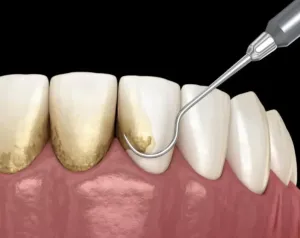
Periodontal Scaling and Root Planning is a conservative
cleaning procedure. The purpose is to remove hard deposits
and infection from beneath the gum and clean the root surfaces.
Deposits of bacterial plaque, calculus, food debris, and pus that
is present in the infected pocket that cause periodontitis are
removed. |
|
| Gingival Curettage |
Gingival curettage removes the soft tissue lining of the
periodontal pockets in order to completely eliminate bacterial colonies and the
mechanical and chemical irritants that cause inflammation to the diseased tissue.
It may be used along with scaling and root planning. The goal is that the gum will
reattach itself to the tooth or will shrink enough to eliminate the pocket. |
|
| Oral Irrigation |
directs anti-microbial (anti-plaque) liquid below the gum line to
flush out and kill germs to allow the regeneration of healthy tissue. |
|
| Fiber Splinting |
Trauma to the teeth can be transmitted to the supporting structures, which get damaged.
This can cause mobility of the teeth. Such mobile teeth may require splinting for a
specified period of time till the supporting tissues heals and the tooth becomes stable.
Splinting is a procedure where the teeth are supported in its position for a period of time.
Splinting involves binding a group of teeth together so that the biting forces are shared
by a large number of teeth instead of being born by the affected tooth. |
|
| |
| Surgical Treatments |
| Flap Surgery |
Might be necessary if
inflammation and deep pockets remain following treatment with deep cleaning and medications.
We will perform flap surgery to remove tartar deposits in deep pockets or to reduce the
periodontal pocket and make it easier for the patient, to keep the area clean. This common
surgery involves lifting back the gums and removing the tartar. The gums are then sutured
back in place so that the tissue fits snugly around the tooth again.
|
|
| Guided Tissue Regeneration |
A more
advanced technique, that utilities a barrier membrane which is placed under the gum and
over the remaining bone called guided tissue regeneration, is used to replace or stimulate
bone and gum tissue destroyed by periodontitis.
- A specialized piece of fabric is sewn around the tooth to cover the crater in the
bone left after cleaning.
- The fabric prevents the gum tissue from growing down into the bone defect and allows
the bone and the attachment to the root to regenerate.
|
|
| Bone Grafting |
In some cases
of severe bone loss, the surgeon may attempt to encourage
re-growth and restoration of bone tissue that has been lost through the disease process.
This involves bone grafting:
- The surgeon places bone graft material into the defect.
- The material may be either bone from the same patient or a substance called
decalcified freeze-dried bone allograft (DFDBA) which is obtained from a donor.
- This material then stimulates new bone growth in the area.
|
|
Advanced Gum Disease Treatments |
| Periodontal Crown-Lengthening Surgery |
Is a procedure to improve a "gummy" smile because your teeth appear short?
In this we remove excess gum and bone tissue to reshape and expose more of the natural
tooth. This can be done to one tooth, to even the gum line, or to several teeth to
expose a natural, broad smile. |
|
| Soft Tissue Grafts - (Gingival Graft) |
Stop further gum recession and improve the aesthetics of the gum line.
The procedure can be used to cover roots or develop gum tissue where absent
due to excessive gingival recession. |
|
| Depigmentation of Gums |
| Before
|
After
|
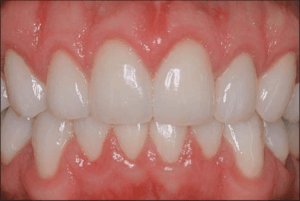
Dark pigmentation of gums can be permanently removed using a surgical procedure.
The dark pigmented areas are removed to expose the naturally pink tissue underneath.
Thus the result is a healthy smile that looks natural and radiates confidence.
It can be performed on individuals of all ages. |
|
|
| |